Then, in 1979, the Ayatollah Khomeini seized power in Iran, which caused a second oil shock, pushing
crude prices from around US$13 to a high of US$32/bbl. This caused an international oil shortage that
resulted in "car-less days" in NZ and provided extra impetus for the expansion. Government became far
more interested in energy development to help redress the balance of payments problem. This was a
consequence of the oil shocks, but also partly due to the "take or pay" agreement the Government had
signed with the Shell/BP/Todd consortium for the Maui gas. Eventually, in 1979, an expansion was
approved the cost of which by now had risen to $320 million. By March 1980, loans of US$500 million had
been secured from International banks, Shell had accepted the technical brief and Badger-Chiyoda had
been approved as the major process plant contractor. However, due to the nature of the contractual
agreement a final price had yet to be agreed. Also, the originally proposed catalytic cracker was being
reviewed against a hydrocracker. The latter fitted in more closely with the total needs for NZ fuels and the
aims of the "Think Big" projects, particularly the Taranaki Syngas plant that had been prompted by the
Maui gas “take or pay” agreement.
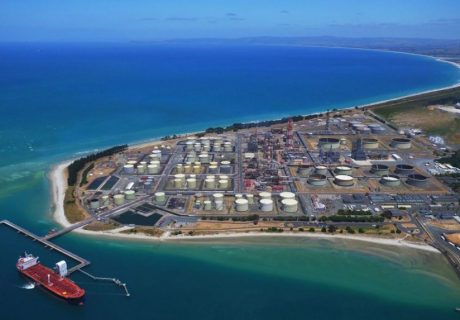
The Refinery
The original refinery was built as a simple "hydroskimming" refinery, i.e. it had a crude distiller unit but
very limited secondary upgrading processes. The crude distiller products consisted of naphtha, gasoil
(diesel), and fuel oil. Naphtha was subsequently upgraded, in octane via a platformer unit to increase the
octane. Sulphur in the gasoil fraction was reduced in a hydrodesulphuriser unit when processing sour
feed in the crude distiller unit. The residue portion was used for either fuel oil or upgraded for bitumen
manufacture. No kerosene or jet fuel was produced.
The expansion in the mid-1980’s was based around a hydrocracker, a process that upgrades low value
residues to high value finished components. The original choice of the catcracker configuration was
based on NZ's perceived need for extra motor spirit. This need was now expected to be partly met by the
synthetic gasoline (Syngas) plant at Motonui. Thus, the NZ energy profile had changed somewhat
through the years of negotiation and the complex interrelationships caused by the "Think Big" approach.
During this period, increases in air travel to NZ and an increase in domestic diesel demand had indicated
a greater need for middle distillates (diesel and kerosene) than could be could be met by a catcracker
configuration.
The hydrocracker unit itself requires further plant to supply feedstock:
- A hydrogen manufacturing unit to provide hydrogen gas for the hydrocracker,
- A high vacuum unit, to treat the crude distiller residue, and
- A butane deasphalting unit (BDU).
This latter unit is of particular interest as NZRC was the first hydrocracker to take feed from such a plant.
Generally, the philosophy is to dig as deep in the barrel as possible (ie to process heavier feed and
produce more high value products), to maximise the profitability of the refinery. However, dig too deep
and the hydrocracker catalyst will coke up, which can be very expensive indeed. The BDU/hydrocracker
configuration was unique, so the eyes of the oil world were on the performance of the new Marsden Point
Hydrocracker Complex. To accommodate the increased production, extra tanks had to be built, as well as
utility supplies (steam, air etc) and environmental treatment units. In all, the expansion was a very large
project, more akin to a building a new, bigger refinery alongside the existing one than just an expansion.
The overall economic effect of the expansion was to increase “white product” manufacture by about 100%
while only increasing crude intake by some 25%. This is achieved by upgrading the high proportion of low
value residue in crude oil to valuable "white products" and is a continuing trend within Industry known as
"whitening the barrel".